
Midges (Chironomids) are two-winged flies of the Nematocera (or lower Diptera). They look something like mosquitoes but do not have their nasty habit of biting! At rest they can be distinguished from mosquitoes by the raised front legs - mosquitoes raise their hind legs. Like mosquitoes, the immatures of most chironomids are aquatic.
John Epler's site gives current information on the taxonomy and distribution of these wonderful groups of insects in Florida and elsewhere.
One of the new endemic species of Jamaica is described below:
Monopelopia mikeschwartzi
Description
Monopelopia mikeschwartzi Epler, n.sp.
Type locality: JAMAICA: Trelawny Parish, Coffee Hill near
Windsor.
Type material: Holotype male, JAMAICA Trelawny Parish, Coffee Hill
near Windsor (77°41'15"W, 18°21'10"N), elevation about 198
m, from phytotelmata in bromeliad Aechmea paniculigera,
April 1995, leg. W. Janetzky. Allotype, female, same collection
data. Paratypes: 2 males, one female, 4 pupal exuviae, 6 fourth
instar larvae, same collection data. Holotype and allotype
deposited in Florida State Collection of Arthropods housed at
Florida A&M University, Tallahassee, Florida, USA; paratypes in
same collection, the Zoologische Staatssammlung, Munchen, Germany,
and the senior author's collection.
Etymology: The new species is dedicated to Mr. Mike Schwartz,
Windsor Great House, Jamaica, for his hospitality and friendship
during the junior author's stay in Jamaica.
Diagnosis:
Adult males are distinguished by the long, pale preapical setae on
palpomere 2; abdominal tergites II-VI with broad basal brown band,
T VII mostly brown with narrow pale apical band and T VIII pale;
and gonostylus <100µm long.
Pupae are distinguished by the brown, patterned exuviae, thoracic
horn with rounded apex and T VII usually with 2 lateral setae and 2
tacniae on each side. Larvae are distinguished by the pale claws of
the posterior parapods, with at least two small claws with 7-9
large inner teeth and the lack of a small dark claw, and AR
2.22-2.53.
Male imago (n = 3; holotype and two paratypes).
Color: Head, dorsum of thorax and postnotum light brown, with light
brown spot on anterior anepisternum and median anepisternum;
scutellum pale; wings clothed with pale brown macrotrichia; legs
pale yellow-brown, with fore femora and tarsi light brown; abdomen
with tergite I pale, T II-V each with light brown band on basal
half; T VI-VII mostly light brown with narrow apical pale band. T
VIII pale, genitalia light 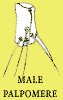 brown.
Lengths: Total 2.08-2.54 mm; thorax 0.63-0.74 mm; abdomen 1.45-1.80
mm.
Head: Setae-temporals 8-10, uniserial, clypeals 15-17, antennal
pedicel 3-4. Cibarial sensillae about 13 (n - 1). Lengths of
palpomeres 1-5: 50-53; 55-65; 120-145; 120-130; 155-200. Palpomere
2 with 5-6 long, pale, preapical setae (see Fig) AR 1.20-1.49.
Dorsal eye extension 3 ommatidia wide.
Thorax: Setae-antepronotals 3-4; acrostichals 26-33, biserial;
dorsocentrals 15-22, biserial anteriorly: prealars 5-6; scutellars
6-8, partially biserial, supraalar 1.
Wing: Length 1.18-1.33 mm; width 0.35-0.45 mm. Brachiolum with 1
large seta near base and 2 smaller distal setae. VR 0.96-1.00.
Legs: Weak tarsal beard on mid and hind legs, with preapical tarsal
pseudospurs present on tarsomeres 1-3 on all legs; palmate sensilla
chaetica not present, but numerous blunt-tipped setae (sensilla
chaetica?) present on all tarsomeres. Tibial spur lengths: fore
30-35; mid 43-50; hind 50. Hind tibia with weak comb of 5
setae.
Lengths and proportions of legs (n = 1):
|
fe |
ti |
ta1 |
ta2 |
ta3 |
ta4 |
ta5 |
LR |
BV |
SV |
|
|
P1 |
600 |
640 |
480 |
330 |
230 |
150 |
90 |
0.75 |
2.15 |
2.58 |
|
P2 |
690 |
590 |
616 |
340 |
200 |
135 |
80 |
1.04 |
2.51 |
2.08 |
|
P3 |
570 |
690 |
- |
- |
- |
- |
- |
- |
- |
- |
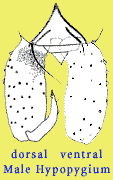 Hypopygium (see
drawing on right): T IX with one large seta on each side. Anal
point conical pointed. Length of gonocoxite 138-155; length of
gonostylus 85-93, HR 1.48-1.82.
Hypopygium (see
drawing on right): T IX with one large seta on each side. Anal
point conical pointed. Length of gonocoxite 138-155; length of
gonostylus 85-93, HR 1.48-1.82.
Female imago (n = 2; allotype and paratype).
Color: Head, dorsum of thorax and postnotum light brown, with light
brown spot on anterior anepisternum and median anepisternum;
scutellum pale; wings clothed
Fourth Instar Larva (n = 3-5 paratypes).
Color: Head capsule pale yellow; antennae with pale yellow first
segment, second pale yellow-brown in one specimen, pale yellow in
other material; apical third of ligula light brown, apices of teeth
paler: apex of mandible light yellow-brown; claws of anterior
parapod pale yellow-brown; claws of posterior parapod colorless to
pale yellow-brown.
Head: Head capsule length 0.51-0.53 mm; width 0.29 mm (n = 2).
Antenna (see drawing) with segment 1 180-190 long, ring organ
0.61-0.65 from base; segment 2 63-72: antennal blade 65-73 long; AR
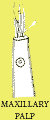
2.22-2.43. Maxillary palp (see drawing) length 30-32, width 9-11;
length of antennal segment 2/length of the maxillary palp
1.97-2.33. Mandible length 78-83. 
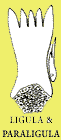
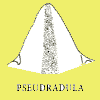
 Pseudoradula (see drawing) slightly
broadened basallyy; Ligula (see drawing) 63-70 long, 28-30 maximum
width; paraligula 29-32 long. Pecten hypopharyngis with 7-8
teeth/side. Dorsal head capsule setae are arranged similarly to
those of M. boliekae as figured by Kowalyk (1985: fig. 117);
ventral chaetotaxy is similar to that of M. boliekae in
Kowalyk's fig. 116, except that SSM, VP and S10 lie in a
straight line at a right angle to the longitudinal axis of the head
capsule, with VP placed directly caudad of S9.
Pseudoradula (see drawing) slightly
broadened basallyy; Ligula (see drawing) 63-70 long, 28-30 maximum
width; paraligula 29-32 long. Pecten hypopharyngis with 7-8
teeth/side. Dorsal head capsule setae are arranged similarly to
those of M. boliekae as figured by Kowalyk (1985: fig. 117);
ventral chaetotaxy is similar to that of M. boliekae in
Kowalyk's fig. 116, except that SSM, VP and S10 lie in a
straight line at a right angle to the longitudinal axis of the head
capsule, with VP placed directly caudad of S9.
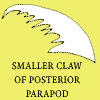
Body: Procerci 57-60 long, 20 wide. Anal tubules 75-108 long, 15-25
wide. Posterior parapod with large claws with fine inner and outer
teeth, two smaller claws with 7-9 large inner teeth (see
drawing).
Discussion
Roback (1986) provided the most recent review of
Monopelopia for the New World; M. mikeschwartzi
belongs to his M. tenuicalcar group. Monopelopia
mikeschwartzi is very similar to M. tillandsia Beck and
Beck morphologically and in choice of habitats; both are denizens
of phytotelmata.
We value your feedback and comments: